Introspective Writing
April 5, 2025Shaping the Exchange Between Performer and Audience
April 15, 2025Navigating a Digital Forest, Crumbs and Consent
Rozul Althea Mariel Lanza
Design is often seen as an aesthetic pursuit, a way to romanticise the environment around us. To me, design also exists as an experience for users, creating spaces that promote human connections and interactions. As technology evolves every day, the need for human centrism becomes paramount, and this should address both the importance of the human nature of socialising whilst safeguarding the security and privacy of users of such platforms for basic human needs.
Blank Separator
A Want-turned-Need
Relating to Maslow’s Hierarchy of Needs, it is a curious observation of how modern-day inventions, like smartphones and computers, address almost every need tier – security in real-time footage, love and belonging through social connections and even boosting creativity for self. But what stands out to me most in particular is the way digital media has become omnipresent in every move and decision we make, having transformed how we engage with each other. Not so long ago, we witnessed the Internet become social, with social media applications like Friendster, Facebook, and WhatsApp popping up, ensuring easy and constant connections in real-time, from work to school to leisure. Sharing our lives on the net daily has become so normative with how posting takes only a few taps and the rise of online influencers, the screens giving a false sense of security. This technology entered users’ lives almost seamlessly, it’s as if it has cemented its position as a necessity right from the start.
The tale of Hansel and Gretel
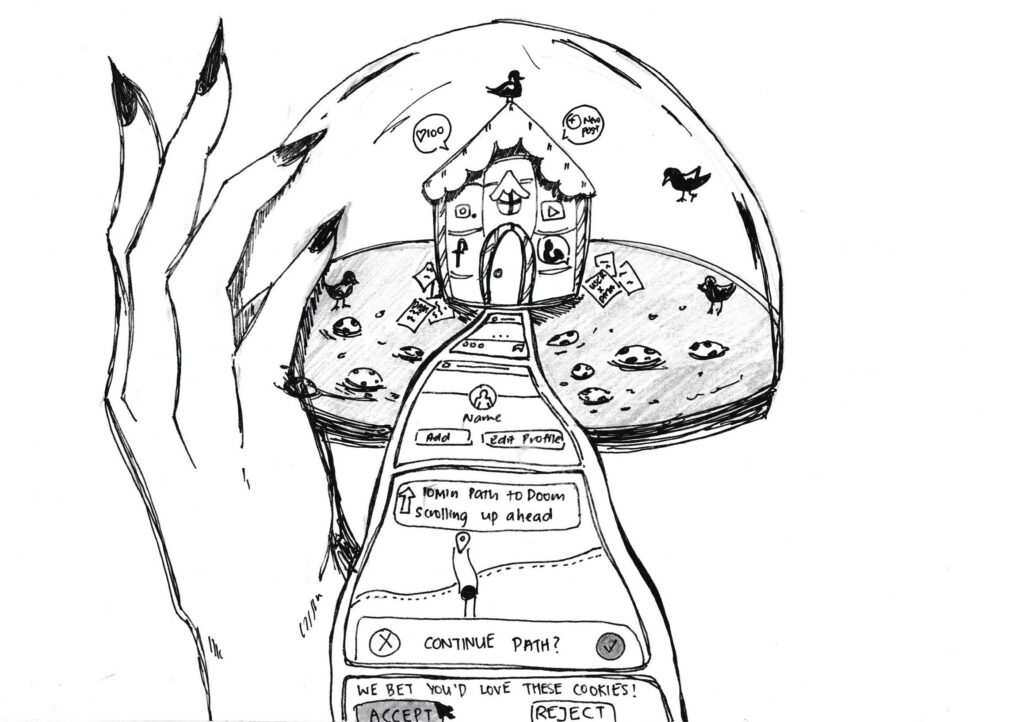
In the Grimms’ fairytale story of Hansel and Gretel, the siblings were led into the woods and used path markers like stones and breadcrumbs to find their way home. Though initially using stones led them back to the safety of their home, using breadcrumbs, however, was ineffective after being consumed by birds, which eventually led them to unforeseen danger – the Witch’s Lair, a house made up of food enticing the hungry children. They met the Witch who invited them in and willingly walked into danger. This tale offers a poignant metaphor for our activities in our digital lives.
We are being fed content we want in exchange for the data we leave.
Isn’t that how algorithms work?
Just as the woods are fraught with uncertainty and risks, the World Wide Web itself has been a labyrinth for exploration for everyone with access to the digital world. With every mindless click, tap, swipe, and scroll—our marks made online—we unknowingly get lost in habits like doomscrolling while leaving behind traces of our personal data. As we crave more and more content, just like starving children, we are led to our own house of feasts, personalised content served to us by online algorithms. The birds symbolise possible third parties such as marketers or data brokers, consumed crumbs being swept away to unknown places without our knowledge too. Both Hansel and Gretel ended up in the Evil Witch’s clutches, leading one to wonder whether there was a deliberate attempt to sabotage the path markers to purposely lead them to this danger.
What if the online world itself was the entire Witch’s Lair after all? An entrapment of its own, one where we get lost in and ultimately it is up to our choices to fall into her clutches or flee back to safety.
But here’s the thing: the children had a choice, and to which they accepted.
“She took them by the hand and led them into her house. Then she served them a
good meal: milk and pancakes with sugar, apples, and nuts. Afterward, she made two
nice beds for them, decked in white. Hansel and Gretel went to bed, thinking
they were in heaven. But the old woman had only pretended to be friendly.
She was a wicked witch who was lying in wait there for children.”
The Witch herself had such a lair to feed herself as well, and eerily, asking for the children’s consent to come in mirrors the cookie pop-ups and terms agreement we commonly encounter. Similarly, companies try to appeal to users, lure them, and feed on their data for their gains. One particular case study that stood out to me recently is about an AI-powered hotel, Otonomus, in Las Vegas, which is advertised as ‘crafting a personalised and intuitive experience tailored uniquely for each guest’. In many ways, this offers an exciting glimpse into the future, a highly personalised experience tailored through the data collected from its guests. This hotel, like many other AI-powered systems, also raises important questions about data usage. Does the pursuit of a personalised experience require an increasingly invasive collection of data? How much is too much of what we are sharing of ourselves online? And with all the current issues that arise together with the evolution of AI, how can we protect ourselves from the potential misuse and weaponization of what we have left online?
With this as its selling point, is it more so that Hansel and Gretel should just not have accepted the Witch’s oNer into her home, she was, after all, ‘Stranger Danger’? Were the children misguided in their actions due to the after-effects of mindless pleasures once biting into the roof, windows, and door of the sweet treat-filled shelter, the same way we
continue staying online from the small dopamine hits we get with every post we come across?
Exploring the woods – or the online realm – then becomes something that we as users should trek more vigilantly to protect ourselves from the potential dangers that lie await.
An inevitable user flaw
“When Facebook was getting going,” Mr Parker said on Wednesday, “I had these people
who would come up to me and they would say, ‘I’m not on social media.’
“And I would say, ‘OK. You know, you will be.’”
The evolving world is becoming increasingly online each day, and we are ultimately dragged into this whether we like it or not. It is interesting how some 20 years ago, an exchange between Facebook’s founding president and users showed how a designed platform has changed society’s behaviour, making people change the way they interact and even creating a new form of addiction.
In the end, design no longer serves the sole purpose of visual beautification – but to empower and protect. As earlier mentioned in social media apps, design has the ability to change behaviours and mindsets, and hence, it becomes important for designers to decide: will they lead others into algorithmic traps or will they empower for more mindful consent and critical thinking to help guide them to safety? Design can trick and manipulate but it can also have a purposeful alternative that respects autonomy and builds trust with users. The tale of Hansel and Gretel reminds us that users have a choice, and design can influence those choices. As a designer and contributor to the digital space, I believe that responsibility falls on us to ensure that the digital woods do not end up as an escapable trap, but rather a place where connections, security and purpose can coexist.
Reference
Grimm, J. and Grimm, W. (1812). Grimm 015: Hansel and Gretel. [online] sites.pitt.edu.
Available at: https://sites.pitt.edu/~dash/grimm015.html.
Lee, D. (2017). Facebook founding president sounds alarm. BBC News. [online] 10 Nov.
Available at: https://www.bbc.com/news/technology-41936791.
Lee, R. (2025). Otonomus: The World’s First AI-Powered Hotel in Las Vegas. [online]
TechInformed – A leading media and marketing solutions platform for IT Decision Makers.
Available at: https://techinformed.com/ai-powered-hotel-otonomus-las-vegas/.